Architectural crystal gifting
Foundation Stones: Integrating Raw Schorl into Architectural Gifting
Raw schorl can work well in architectural crystal gifting when it is treated as a symbolic, tactile object for a new space, not as a building material, safety feature, or guaranteed energetic tool. The clearest use is modest: choose a raw piece with enough visual presence to feel intentional, give it as a housewarming or studio-opening keepsake, and frame the gesture around memory, place, and beginning.
The boundary is just as important. A raw schorl housewarming gift belongs beside architecture, not inside it. It can sit on a shelf, entry table, desk, windowsill, altar-like surface, or another visible place chosen by the recipient. It should not be buried in foundations, embedded in walls, placed near wiring or plumbing, or described as improving how a home performs.
broader context
Black tourmaline context note
This narrower page works best after the broader black tourmaline context page.
What “foundation stone” can mean here
For this page, “foundation stone” is contemporary symbolic language. It can mean: “Here is a small object to mark the beginning of this home, studio, room, or working space.” It does not need ancient authority, universal ritual history, or a measurable effect on the building.
Raw schorl suits that meaning because it often reads as weighty, dark, linear, and mineral rather than soft or ornamental. In a gift context, that surface language can suggest steadiness, boundary, and arrival. Those are interpretations, not proofs. The stone gives the recipient a physical marker; the meaning comes from the giver, the recipient, and the moment.
That distinction keeps the gift respectful. Many people use words like grounding, protection, cleansing, shielding, or energy when they talk about black tourmaline. Those words may belong to a personal belief system, but they should not be presented as guaranteed outcomes. A more careful note might say, “I chose this as a symbol of steadiness for your new threshold,” rather than telling the recipient what the stone will do.
A symbolic foundation stone gift is strongest when it stays generous and unpressured.
How to choose raw schorl for a new home or physical space
For a gift, the first question is not whether the specimen is “powerful.” It is whether it suits the person and the room. A raw schorl threshold token for a minimalist apartment will be different from a larger studio keepsake for someone opening a ceramics room, writing space, or workshop.
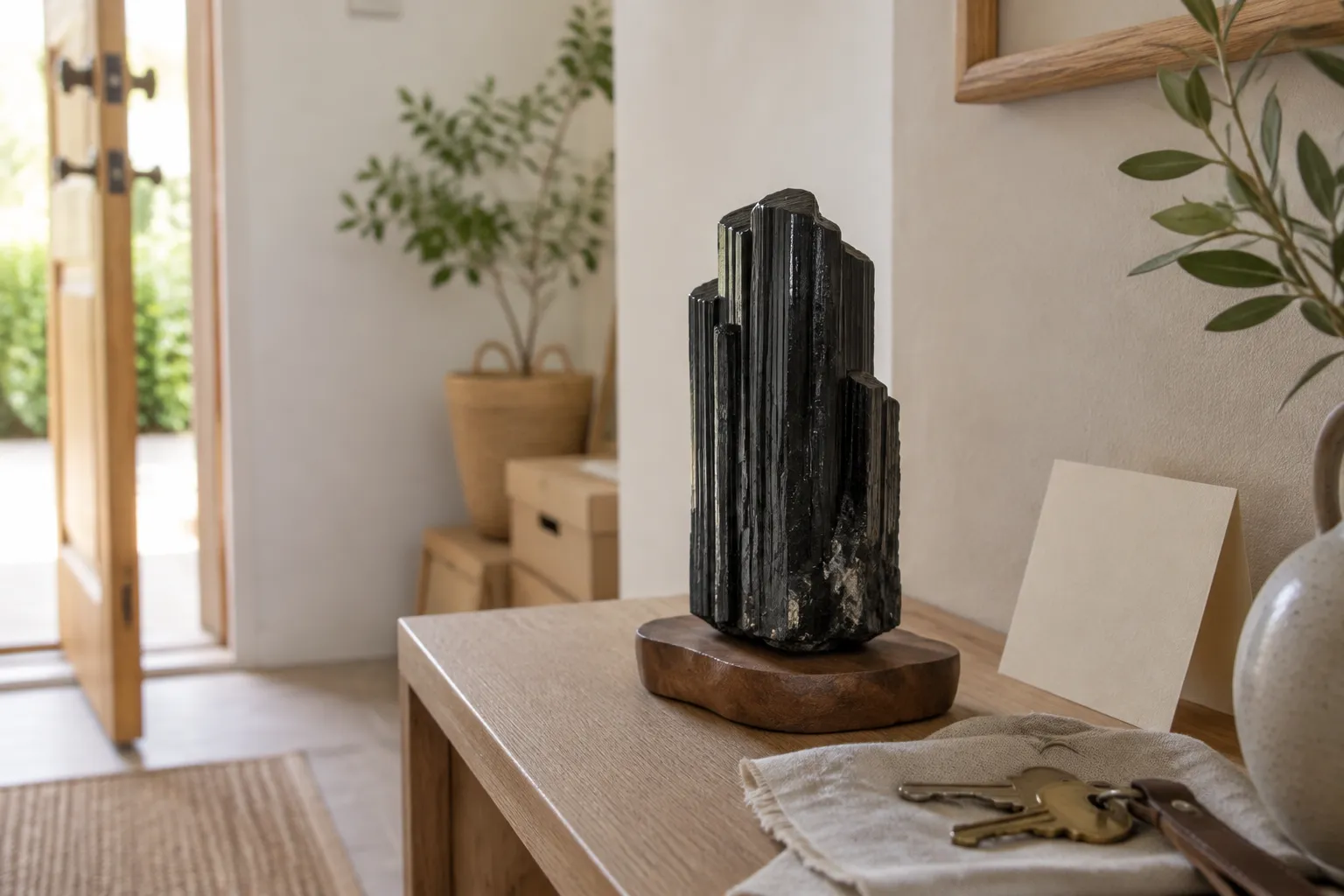
Look for a piece that feels intentional in scale. A tiny fragment may disappear on an entry table unless it comes with a card, tray, or small base. A very large specimen may become a burden if the recipient has limited shelf space, pets, children, or a lighter interior style. For most new home intentional gifts, a hand-sized piece or compact cluster is easier to place without asking the recipient to rearrange a room.
Surface also matters. Raw schorl is often chosen because it looks unpolished and architectural: dark faces, ridges, striated lines, broken terminations, or blocky mass. Since this page does not have visible source material to support detailed identification claims, avoid turning the gift into a certainty statement about origin, grade, or mineral verification unless you have reliable documentation from the seller.
As a giver, you can say what you observed: “I liked the ridged surface and the way it holds light.” That is cleaner than “certified high-grade schorl” unless that wording is actually documented.
If the recipient cares about authenticity, include the purchase details you have without overclaiming. A simple label such as “raw black tourmaline / schorl” is more honest than elaborate claims about purity, rarity, or provenance. Material evidence before meaning keeps the gift grounded.
Placement ideas that stay outside building work
Architectural schorl placement ideas should be about visibility, touch, and personal meaning. They should not involve construction cavities, foundations, structural assemblies, ventilation paths, electrical panels, plumbing routes, or drainage areas. If a placement would require tools, alteration, code knowledge, or access to building systems, it is no longer a symbolic gift placement.
Good low-interference locations include:
- Entry table or console: A raw piece can mark the threshold as a place of arrival. Keep the wording symbolic: “a threshold marker,” not a functional barrier.
- Bookshelf or mantel: This works when the recipient likes objects with weight and texture. The stone becomes part of the room’s visual rhythm.
- Desk or studio shelf: For a new office, creative room, or work area, schorl can serve as a keepsake for beginning work in a physical place.
- Window ledge or plant-adjacent surface: This can support a biophilic home integration feeling through contrast: mineral, plant, light, wood, and shadow.
- Small tray near keys or mail: This keeps the object practical in scale and avoids turning the whole home into a ritual arrangement.
If you suggest placement, make it optional. The recipient may not want a crystal at the front door. They may prefer a private shelf, a workbench, or a drawer with other keepsakes. Good architectural crystal gifting leaves room for taste, belief, and household limits.
A simple rule helps: the stone can belong to the story of the space, but it should not interfere with how the space functions.
A simple gifting structure: object, note, and consent
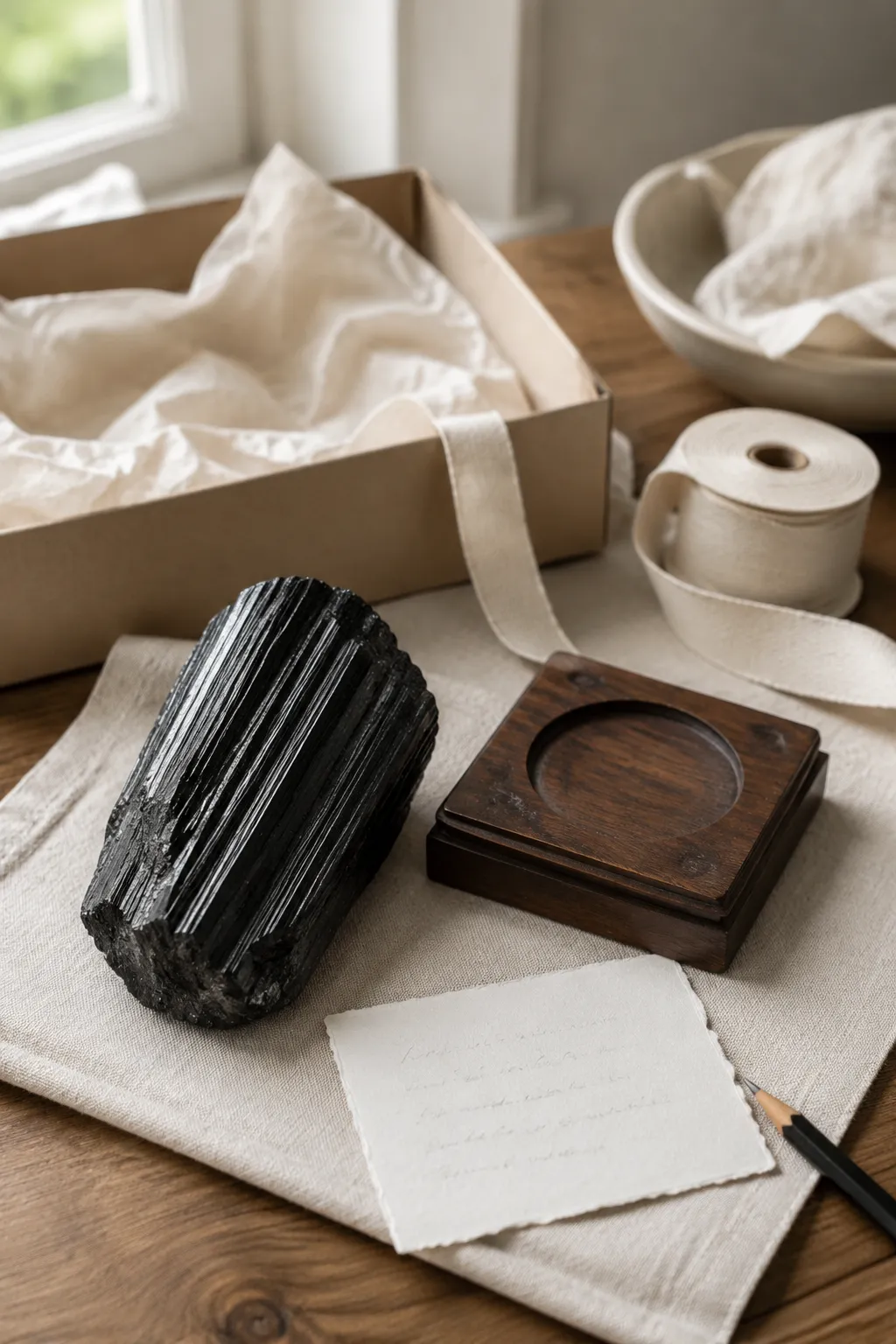
A raw schorl housewarming gift becomes more thoughtful when it is framed lightly. It does not need dramatic instructions. A complete presentation can be as simple as the stone, stable wrapping or a small display surface, and a note that explains your intention without assigning beliefs to the recipient.
Respectful crystal gift packaging can be plain and tactile. A linen pouch, rigid box, paper wrap, or cloth bundle is enough. If the specimen has sharp edges, wrap it so it does not scratch furniture or hands during opening. If the recipient may display it, a small tray, felt pad, or card base can help separate the raw surface from delicate wood, glass, or painted shelves. This is practical courtesy, not a mineral claim.
The note matters more than the ritual. Crystal gift note wording should stay warm, specific, and non-imposing. For example:
- “For your new home: a small piece of raw schorl as a symbol of steadiness at the beginning.”
- “I chose this for the studio because it has a strong, quiet presence. Place it wherever it feels visually at home.”
- “A threshold token for this new chapter; no instructions attached, just a marker of care.”
- “For your shelf, desk, or entryway, if you’d like an object to mark the space.”
These notes work because they offer meaning without making claims. They do not tell the recipient what the stone will do. They give the object a reason to be there.
If you know the recipient shares crystal symbolism, you can use slightly more ritual-friendly language: “If you like intention-setting, this can mark the first week in the new space.” Still, avoid promising results. The gift should feel like an invitation, not a prescription.
When raw schorl is not the right architectural gift
Raw schorl is not ideal for every home. It may be the wrong choice if the recipient dislikes crystals, avoids spiritual objects, has a highly curated interior, or would feel pressured by ritual language. It may also be impractical in households where small heavy objects are easily knocked down or where rough mineral surfaces could scratch furniture.
It is also the wrong choice if the giver wants the stone to stand in for real home care. Symbolic placement in interiors should never replace inspection, repair, maintenance, environmental testing, professional evaluation, or ordinary safety practices. If a new home has concerns about wiring, moisture, air quality, drainage, pests, structure, or code-regulated systems, those belong to qualified building and maintenance channels.
The same applies to wellness language. A stone can be part of a personal routine, a visual anchor, or a meaningful object someone enjoys. It should not be framed as changing health outcomes, resolving distress, or providing measurable protection. For a nervous-system-aware recipient, the safer wording is about attention and environment: “a tactile reminder to pause at the doorway,” or “a visual cue for arriving in the room.” That keeps the statement in the realm of personal practice.
Common confusion: architecture language versus actual architecture
The phrase “architectural crystal gifting” can be misleading if it sounds like the crystal is being integrated into the building itself. For raw schorl, that is not the right interpretation. “Architectural” should refer to the object’s relationship to space: scale, placement, threshold, texture, shadow, and the way it sits among other materials.
Think of it like a stoneware vessel, a wooden bowl, or a small bronze object. It can change how a surface feels visually. It can mark a transition point. It can become part of a room’s lived pattern. But it is not part of the building’s structural, electrical, mechanical, or environmental performance.
Foundation stone rituals can be meaningful as private gestures. Someone might place the stone on a table while saying a few words about the home they hope to create. Someone else might simply set it on a shelf after moving in. Both are enough. The ritual does not need to be elaborate, borrowed from a culture the giver cannot document, or presented as universally valid.
The cleanest version is personal: “This marks the beginning of this space.” That sentence is strong because it does not overreach.
A restrained way to give raw schorl as a housewarming object
If you want the gift to feel complete, keep the process small:
- 1. Choose the room meaning first. Is this for an entryway, studio, desk, shelf, or shared living space?
- 2. Pick a manageable piece. Favor stable scale, pleasing surface, and easy display over dramatic claims.
- 3. Package it so it can be handled. Protect hands, furniture, and the stone’s edges during opening.
- 4. Write a note with optional meaning. Use words like symbol, marker, keepsake, threshold, steadiness, and beginning.
- 5. Avoid mandatory instructions. Let the recipient decide whether it belongs in view, in a private corner, or not on display at all.
- 6. Keep it separate from building systems. No embedding, burying, wiring-adjacent placement, or construction involvement.
This approach keeps schorl for physical spaces in the right lane: material presence, gift intention, and room-scale symbolism.
The bounded answer
Raw schorl can be a thoughtful architectural gift when it is given as a symbolic foundation stone: a dark, tactile mineral object that marks a new home, studio, threshold, shelf, or work space. It is most appropriate when the recipient is open to crystal symbolism or simply appreciates natural materials in interiors.
The gift becomes less appropriate when it is framed as a guaranteed energetic object, a wellness intervention, an architectural component, or a substitute for real building care. Keep the stone visible, optional, and separate from construction. Let the note carry the meaning; let the house remain a house.
A raw schorl gift does not need to promise anything. Its value is quieter: weight in the hand, texture on a surface, and a small marker of arrival in a new physical place.