Lapidary planning note
The Geometry of Schorl: Mastering the Natural Hexagon Cut
A natural hexagon cut in black tourmaline is best understood as a preservation choice, not a fixed recipe. When a schorl specimen already suggests a six-sided or column-like form, the cutter’s judgment is to follow the visible geometry where it helps the stone read more clearly, and to stop before symmetry erases the mineral’s own surface character.
That is the core answer for cutting hexagon black tourmaline: read the specimen first, choose the face or section that best carries its natural geometry, remove only what interrupts that form, and treat every technical decision as conditional.
There is an evidence limit here. The available material for this page does not include usable external references for schorl crystal habit, saw orientation, polishing sequence, fracture behavior, or lapidary safety. So this article can offer a careful planning lens, but not a complete cutting protocol or a source-backed technical manual.
broader context
Start with the main black tourmaline page
This narrower page works best after the broader black tourmaline context page.
Start With the Shape the Specimen Already Gives You
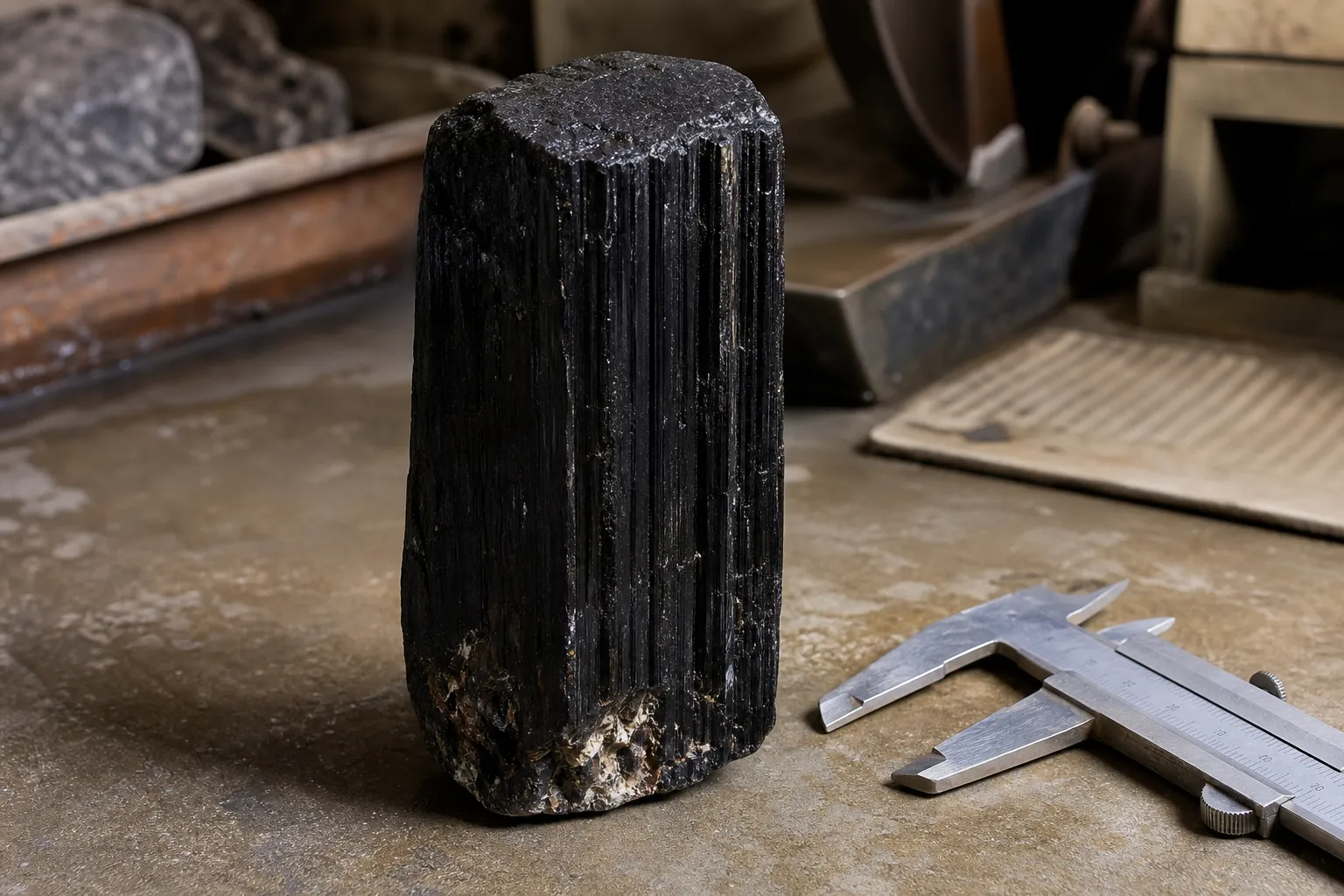
The strongest reason to consider a hexagon-preserving cut is visual continuity. Black tourmaline often carries its presence through dark mass, linear surface, ridges, striations, and a column-like feel. If the specimen already has a readable geometric rhythm, forcing it into a standard gem outline can make it feel less like schorl and more like a design object placed over the mineral.
That does not make every piece a candidate. A specimen may look promising from one end and become irregular, fractured, visually weak, or poorly balanced from another angle. A visible outline can suggest a direction; it cannot certify how the material will behave under cutting or polishing.
The better first question is not, “Can this become a perfect hexagon?” It is, “Does the existing form give enough readable geometry to preserve?” A natural-looking hexagon usually depends on restraint. The cut should clarify the form, not chase mathematical correction until the stone loses its surface story.
How a Hexagon-Preserving Cut Is Planned, in Principle
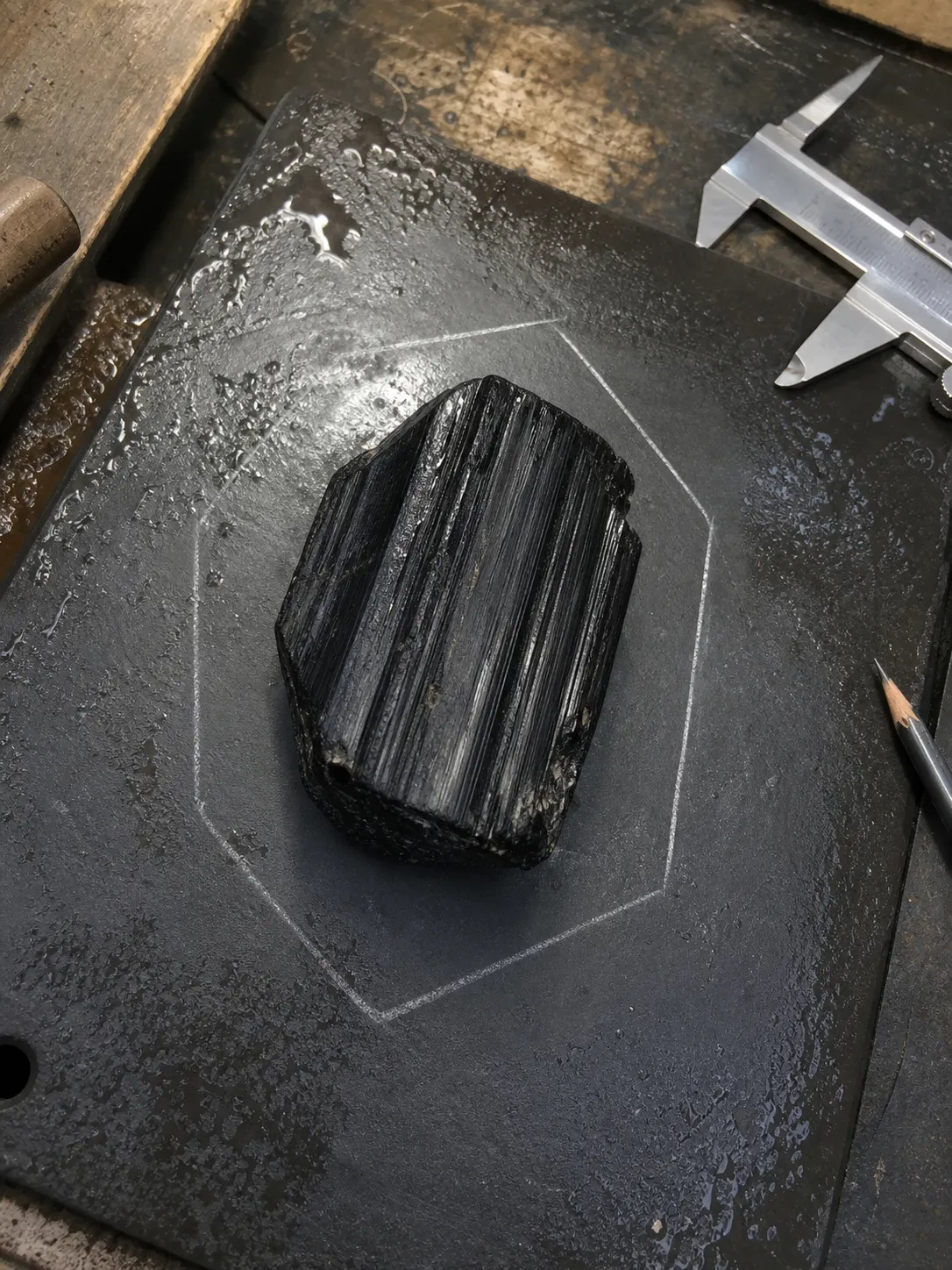
At this level, planning begins with orientation. Saw orientation means the direction a cutter chooses before opening or separating the specimen. Because this page does not have source-backed technical instruction, the responsible discussion stays conceptual: the chosen direction should serve the face, end, or cross-section that best preserves the visible geometry while avoiding unnecessary removal.
For schorl cross-section cutting, the design question is often whether the end view, side view, or an angled view carries the strongest mineral logic. An end view may emphasize a compact geometric face. A lengthwise approach may keep the column feeling more intact. An angled choice may be expressive, but it can move farther from natural crystal shape preservation.
Useful lapidary geometry techniques here are not about imposing a diagram. They are about choosing reference lines: the most balanced center, the clearest edge sequence, and the side that can lose material without losing identity. The finished outline should feel intentional while still belonging to the original specimen.
A simple planning sequence
- Identify the dominant visible geometry.
- Choose the face or end that should become the main visual plane.
- Mark what can be removed and what should be protected.
- Keep the hexagon readable, not necessarily exact.
- Stop before refinement turns preservation into over-shaping.
This is a planning aid, not a substitute for training, equipment knowledge, or safety instruction.
What Changes the Answer
The answer changes when the specimen stops supporting the geometry. A piece may show a pleasing outline but have irregular mass, unstable-looking breaks, or surface interruptions that make a hexagon less convincing. Since this page does not have verified source material on fracture risk, it should not claim which internal features predict failure. Apparent geometry is one signal, not a guarantee.
Size also matters. A small piece may not offer enough material to refine the outline without losing character. A larger piece may allow more choices, but extra material can tempt overworking. In a preservation-minded cut, a slightly irregular hexagon may be stronger than a corrected one that no longer feels connected to the original crystal habit.
Surface character can matter as much as outline. If the exterior has strong ridges, lines, or other schorl-specific cues, those features may be more valuable than a fully flattened polished face. If the exterior is already worn or visually quiet, a more refined surface may carry the design better. The decision is geometric, but it is also about which surface tells the clearest material story.
Finish changes interpretation, too. This page should not prescribe a polishing sequence, grit progression, tool speed, or finish method. At the planning level, a high polish can make the object read as deliberate lapidary work, while a more restrained finish can keep it closer to a mineral specimen. Neither finish is automatically more authentic.
Intended use changes the decision. A display specimen, small interior object, and jewelry component ask different things of the same material. This page does not make durability, market, or wearability claims; it only notes that use affects how much precision, edge refinement, and surface regularity a reader may expect.
The Common Confusion
The main confusion is assuming that natural geometry makes the cut easy. A visible hexagonal suggestion can inspire the work, but it does not mean the material will behave predictably under saw, wheel, or polish. Any stronger claim would be false confidence without better support.
Another confusion is treating the hexagon as the whole point. In a thoughtful black tourmaline cut, the hexagon is a frame for the mineral, not a costume placed over it. If every edge is corrected until the piece becomes a generic six-sided object, the cut may lose what made schorl worth preserving: dense visual weight, directional surface, dark presence, and the tension between natural irregularity and human refinement.
Symbolic or retail language can also blur the issue. Black tourmaline is often discussed in interior and wellness-adjacent settings, but those meanings cannot carry the technical argument for cutting. It is reasonable to say that a hexagon-preserved piece may feel visually grounded in a room because of mass, texture, and geometry. It is not reasonable to present that feeling as a guaranteed effect. Material evidence comes first.
The same caution applies to authenticity. A hexagonal outline does not prove that a specimen is natural, untreated, valuable, or correctly identified. This page has no gemological testing evidence, provenance records, or source-backed identification criteria. A hexagon cut can preserve a schorl-like visual language, but it cannot authenticate the stone on its own.
A Practical Checklist Before Cutting
Use this as a planning checklist, not a technical procedure:
- Does the specimen already show a readable geometric direction?
- Would cutting reveal the form more clearly, or erase the best surface?
- Is the desired hexagon based on the material, not only on a design trend?
- Does the plan allow some irregularity to remain?
- Are tool handling, dust control, cooling, eye protection, and other shop practices being addressed through credible lapidary instruction outside this article?
- Is the finished use realistic for the size, surface, and apparent condition of the piece?
Cutting, grinding, and polishing minerals can involve tools, fragments, wet work, dust, and eye or respiratory concerns. Because the available material does not support a full safety protocol, anyone intending to cut should rely on qualified lapidary instruction, appropriate equipment guidance, and credible safety information before acting.
For readers commissioning the work rather than doing it themselves, the same checklist helps sharpen the conversation. Ask what geometry is being preserved, what surface will remain, how much material will be removed, and where the cutter’s judgment begins and ends. That is more useful than asking only for a “hexagon black tourmaline” result.
Where This Page Stops
This is a narrow practical discussion, not a full mineralogy reference, cutting class, safety manual, buying guide, or spiritual interpretation of black tourmaline. The available research material does not support precise statements about crystal structure, cleavage, hardness behavior, saw settings, polishing compounds, fracture prediction, or identification tests.
That limit does not make the question unanswerable. It changes the answer into something more careful: a lapidary-minded reader can approach cutting hexagon black tourmaline by treating the natural geometry of schorl as a design guide, not as a technical certainty. The best plan starts with the specimen’s visible form, preserves what gives it mineral character, and refuses to let symmetry become more important than material truth.
In an interior or display context, that restraint is part of the object’s value. A preserved hexagon can hold black tourmaline at room scale: dark, structured, tactile, and quiet. The cut is strongest when it makes the mineral easier to read without pretending that the shape proves more than it can.