Resetting Room Energy: How to Use Dark Minerals to Neutralize Heavy Atmospheres
A dark mineral can support a room reset when it is used as a visible symbolic anchor, not as a force that fixes the room on its own. Clear the practical causes of heaviness first, place the specimen where the room naturally gathers attention, name what you are releasing, and let the object mark a return to a neutral baseline. In this article, Spatial Energy Transmutation means personal-practice language: a way to frame attention, atmosphere, and transition. It is not a verified physical, medical, environmental, or technical process.
Black tourmaline often suits this role because its dark color, textured surface, and visual weight read as steady at room scale. That does not make it a replacement for ventilation, cleaning, moisture checks, repairs, conflict resolution, medical care, mental health support, or ordinary safety work.
broader context
Broader schorl guide
This narrower page works best after the broader black tourmaline context page.
Start With the Room, Then Place the Mineral
A useful dark mineral room reset has two layers. The first is ordinary room care: air, light, surfaces, clutter, odor, noise, dampness, and practical safety. The second is ritual framing: placement, words, and a short action that helps you mark a felt change in the room.
If the air is stale, open a window when conditions allow. If the space feels visually tense, remove the most distracting clutter before adding the specimen. If there is persistent odor, dampness, visible damage, or an electrical concern, treat that as a practical issue first. A black tourmaline room reset works best as a symbolic layer placed over basic room attention, not as a substitute for it.
This distinction keeps phrases like “clear negative energy” and “neutralizing heavy atmospheres” in the right register. Here, they describe a personal ritual vocabulary for naming a shift; they do not claim that a mineral has changed air quality, health outcomes, electrical conditions, or hidden contamination.
A Bounded Dark Mineral Room Reset
Choose one narrow role
Choose one dark mineral and give it a narrow role. Black tourmaline is a common choice in this vocabulary when the desired mood is grounded, contained, and visually quiet. If you choose another dark mineral, keep the same standard: it should be stable, safe to place, and clear enough visually to act as a focal point rather than more clutter.
Prepare the room in ordinary terms
Put away loose items that do not belong there, wipe the surface where the specimen will sit, adjust harsh lighting, and address any immediate source of discomfort that has a practical fix. This keeps the ritual from carrying a job that belongs to housekeeping, repair, ventilation, or communication.
Place the mineral deliberately
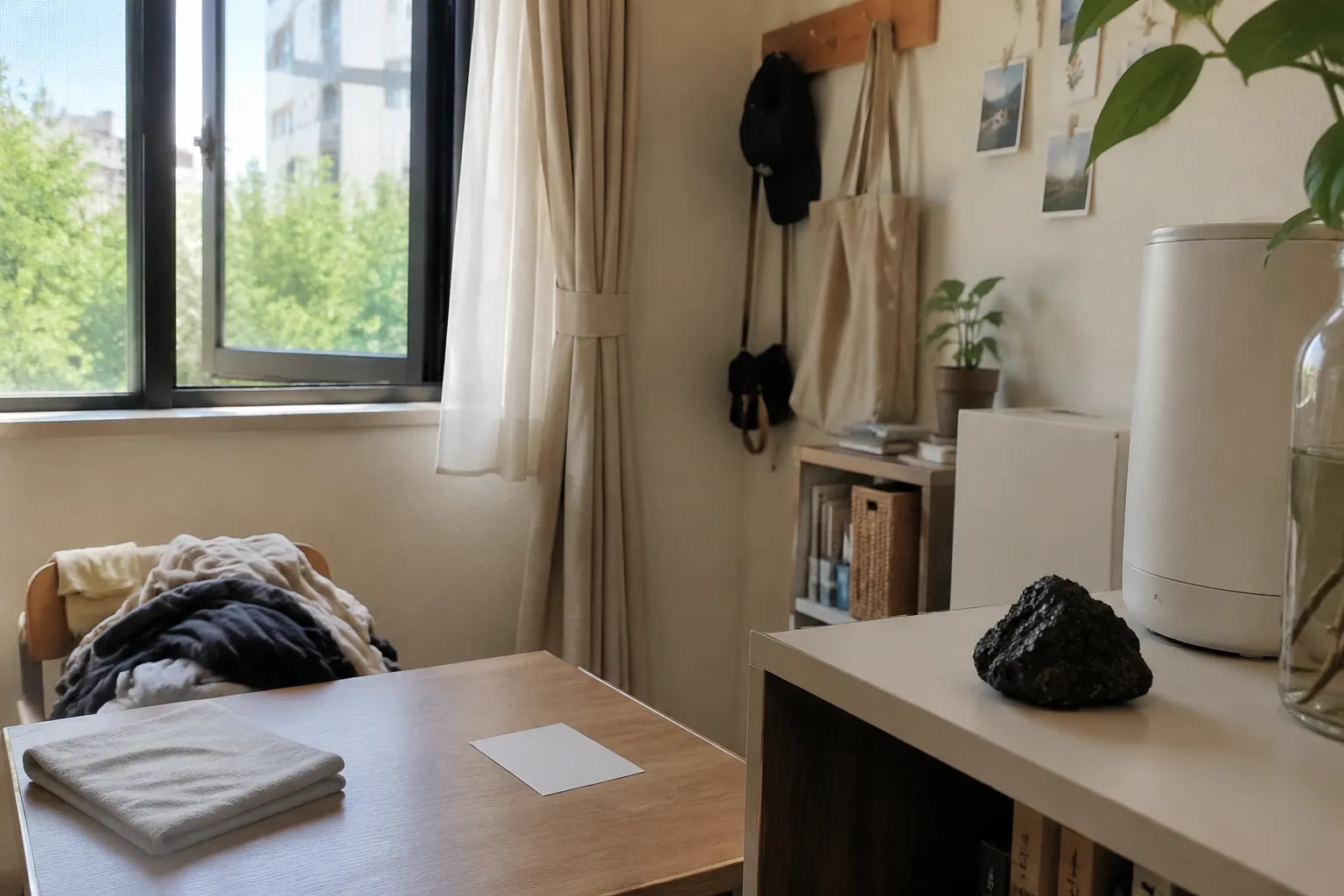
A desk corner can mark the end of tense work. A shelf near the entry can set a threshold. A side table can support a room used for quiet after social intensity. Use a low, stable surface where the specimen will not be knocked over. Avoid placement near small children, pets, food preparation, wet areas, unstable shelves, or equipment where a falling object could interfere with use.
Use a short reset statement
Keep it plain: “This room is returning to a neutral baseline,” or “I am clearing the atmosphere here and beginning again.” If “clear negative energy” belongs to your practice, use it as symbolic language rather than an outcome promise. The point is to give your attention a boundary: before this moment, the room carried one mood; after this moment, you are choosing a different way to inhabit it.
Stay with the room briefly
You might sit, breathe normally, lower the lighting, straighten one remaining surface, or simply let the placed specimen become the visual punctuation mark for the reset. The practice is complete when the room has a clear before-and-after cue, even if your mood is still catching up.
What Changes the Answer
The best placement and ritual tone depend on why the room feels heavy. After an argument, the mineral can mark a pause, but it cannot do the relational work. Silence, repair, privacy, an apology, or time away from the room may matter more than the object.
After long screen work, the reset may be more useful when paired with a lighting change, a cleared desk edge, tidied cables, and a glass of water kept away from electronics. The dark mineral then becomes a boundary object: work has stopped, and the room is no longer holding the same task pressure.
If the heaviness comes from poor air, odor, dust, or moisture, the specimen should not be the main intervention. Ventilation, cleaning, odor control, and moisture checks come first. The mineral can still sit in the room as a personal marker, but it should not be treated as environmental remediation.
If several people use the room, avoid framing the ritual as a verdict on someone else’s presence. A bounded room-atmosphere reset works better as shared care: clear the table, open the space, lower visual noise, and set one object as a neutral point. That keeps the practice respectful rather than accusatory.
Why Black Tourmaline Fits the Symbolic Role
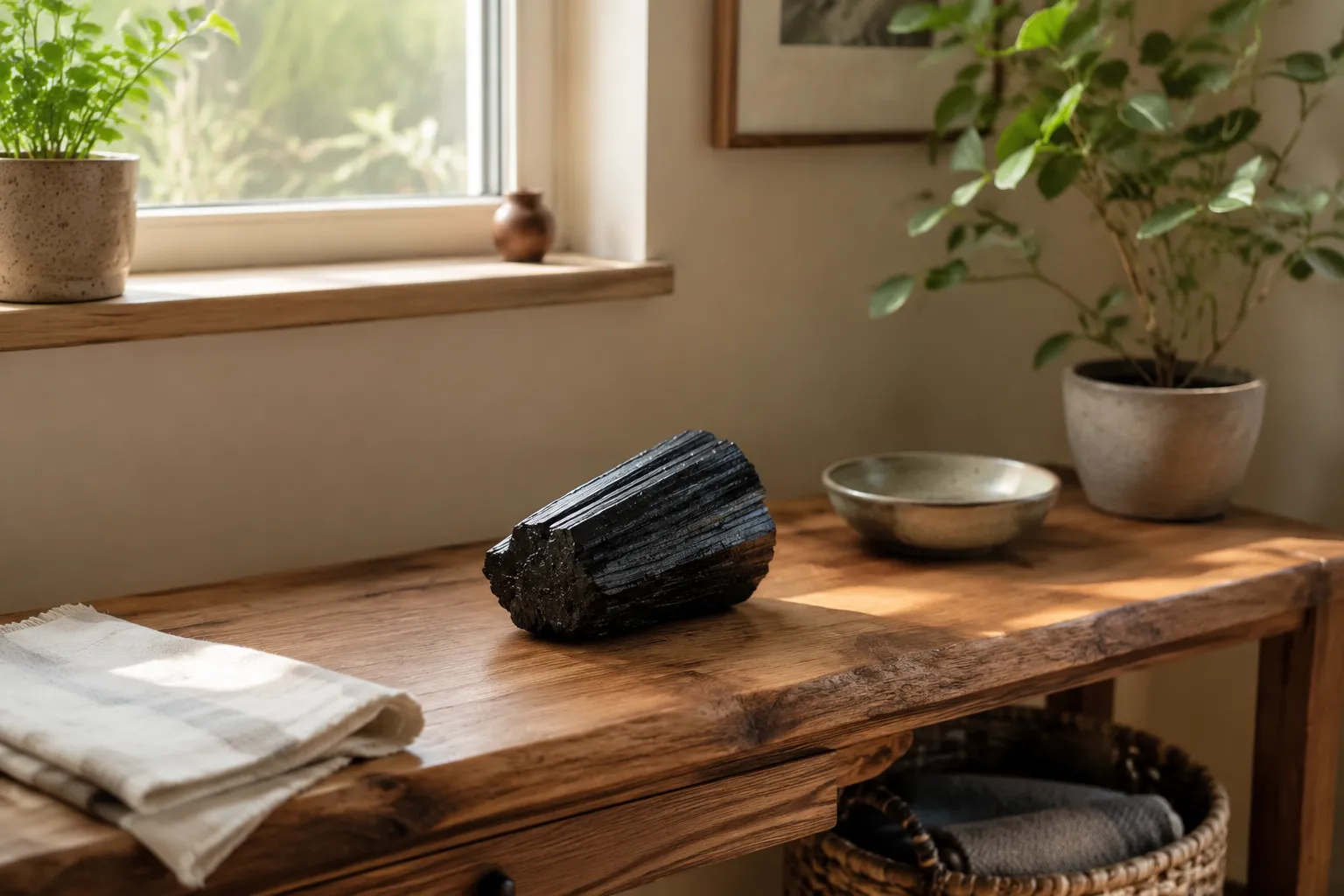
Black tourmaline is often chosen because it visually carries weight. A dark, structured specimen reads differently from a pale decorative object; it can make a shelf, threshold, desk, or bedside surface feel more anchored through contrast, texture, and mass. That is an interior and symbolic observation, not a scientific conclusion about energy transfer.
In a design-conscious room, the mineral’s work is partly visual. A rough or striated surface can interrupt glossy finishes. A matte black piece can quiet a bright shelf. A heavier-looking specimen can give a room a point of gravity. These are ordinary biophilic interior cues: natural material, tactile surface, shadow, and placement.
The authenticity question should stay modest on this page. Without stronger sourcing or a specimen-specific check, this article cannot tell you whether a given piece is schorl, another black mineral, glass, treated material, or a manufactured object. If mineral identity matters, do not rely on ritual language or seller claims alone. The room reset can still be meaningful as a personal practice, but authenticity needs separate evidence.
Common Confusion Around Clearing Negative Room Energy
The main confusion is treating ritual language as a physical mechanism. Spatial Energy Transmutation may be meaningful as a way to organize attention, close a difficult period, or return a room to a neutral baseline. It should not be presented as a verified process that removes toxins, mold, pathogens, electromagnetic exposure, electrical hazards, chemical contamination, trauma, or measurable negative energy.
Another confusion is expecting the mineral to carry the whole reset. A heavy atmosphere is often mixed: stale air, low light, unfinished chores, emotional residue, work stress, noise, or the memory of a tense conversation. A dark mineral can give the reset a visible center, but the room usually changes more when the object is paired with one or two concrete actions.
A third confusion is letting the practice become fear management. If the ritual makes the room feel more threatening, contaminated, or dependent on the object, simplify it. The specimen should mark steadiness, not urgency.
Quick Check Before You Call the Room Reset
Use this as a practical check, not a rule set:
- The room has received basic attention: air, surface, clutter, light, odor, or noise.
- The mineral is placed safely and intentionally, not balanced where it can fall.
- The reset statement is symbolic and specific.
- Any practical problem remains practical; the mineral is not being asked to fix it.
- The room has one clear cue that says the previous atmosphere is over.
If those points are present, the practice has enough structure. More objects, longer wording, or stronger claims do not necessarily make it more useful.
Where the Evidence Stops
No high-quality public sources were available in the current research set for this page, so this article cannot claim scientific validation, cultural lineage, professional testing, documented user outcomes, mineralogical mechanisms, safety guarantees, or environmental effects. That limit matters because room energy language can sound more certain than the evidence allows.
What can be said carefully is narrower: a reader may use black tourmaline or another dark mineral as a symbolic focal object in a room-atmosphere reset ritual. The practice can be paired with ordinary room care and framed around attention, placement, and a chosen neutral baseline. It may be personally meaningful, but it should remain optional, bounded, and separate from health, safety, environmental, or technical claims.
Short Answers
Can black tourmaline neutralize a heavy atmosphere?
It can be used as a symbolic object for neutralizing heavy atmospheres in personal ritual language. This page does not treat that as a physical effect or a substitute for ordinary room care.
Where should I put a dark mineral for a room reset?
Place it where the room naturally gathers attention: near an entry, on a cleared desk, on a stable shelf, or beside a seating area. Choose a safe, visible location rather than a hidden or unstable one.
Is clearing negative room energy the same as cleaning the room?
No. Cleaning, ventilation, odor control, and moisture checks address practical conditions. Clearing negative room energy, as used here, is a symbolic reset practice that may sit alongside those actions.
A dark mineral is most useful at room scale when it stays honest: an object with weight, texture, and placement, used to mark a shift in attention. Let black tourmaline hold the visual center if it suits the room, and let the room itself receive the practical care it needs.